Showing posts with label chicks. Show all posts

Friday, 31 May 2013

Visitors from far and wide this week as our new chick continues to progress well

We have had a very exciting week so much has gone on ...


Iona and Fingal nurturing their young chick which is three weeks old , the chick is standing about 18 inches
Iona with her new chick
 tall
covered with white downy fluff soon to be feathers.
Iona has been spending more time off the nest but in a tree near by not far away to protect the chick .
Fingal disappeared for two days but came back and was seen on Tuesday afternoon.

The food larder has reduced around the nest this week and so we have had good views of the chick this week.

Most of the food has been sea birds and fish we have had one lamb since we started on March 20th 2013. This came in over two weeks ago and there are still remnants of it on the nest.

I have noticed in the last two weeks several people revisiting us that came in March. It is excellent to see people coming back to this magical Island and seeing the wonderful views of the majestic birds.

We have had some excellent feed back again this week and I love working with John Clare the RSPB ranger who is very knowledgeable , I bring to the group my wealth of experience of visiting this island for 22 yrs and now living here permanently, having bought our house nine years ago.


John and I have been working hard on upgrading our Silver Green Tourism award  to Gold.  We have made a few changes to the site and also added such things as recycling rain water, cycle-stand made by recycled wood, green tourism feedback and suggestion box and a wind up torch. Not that we need it at the moment as its so light up here! 

During the week we have had people from America , Germany and Norway.
The German couple were late over due to ferry delays and arrived when we had just finished, so I took them down to the hide and they had their own private viewing. We had a wonderful time .
We also had another German gentleman who saw a black stork at Dervaig which he regularly sees in his home country.

On Wednesday the old nest Icthy and Scratchy arrived from Loch Frisa. This was the nest that was filmed by Simon King for Springwatch. It has many different memories for previous staff that worked at the hide and the public, who like myself, watched every programme religiously, in awe of these wonderful rare birds..

I will be using it as a demonstration piece to the groups and school children who are soon to visit .

Norwegian visitors to the Mull wildlife hide

We have had many visitors to the hide this week and the weather has been brilliant , so come and see us .

On Friday we had a group of Norwegian people visit. The group were from an organisation who organise wildlife trips, so they were interested in the running of the hide. They were particularly interested in the things that go on behind the scenes to make it work and of course the history of the birds, since the reintroduction programme was helped by Norway, providing the young chicks and the start of them living back on the Isle of Mull.
 I took a day off and managed to get a picture of that rare bird the corncrake so I have included it as I know many of you are serious about your birds!
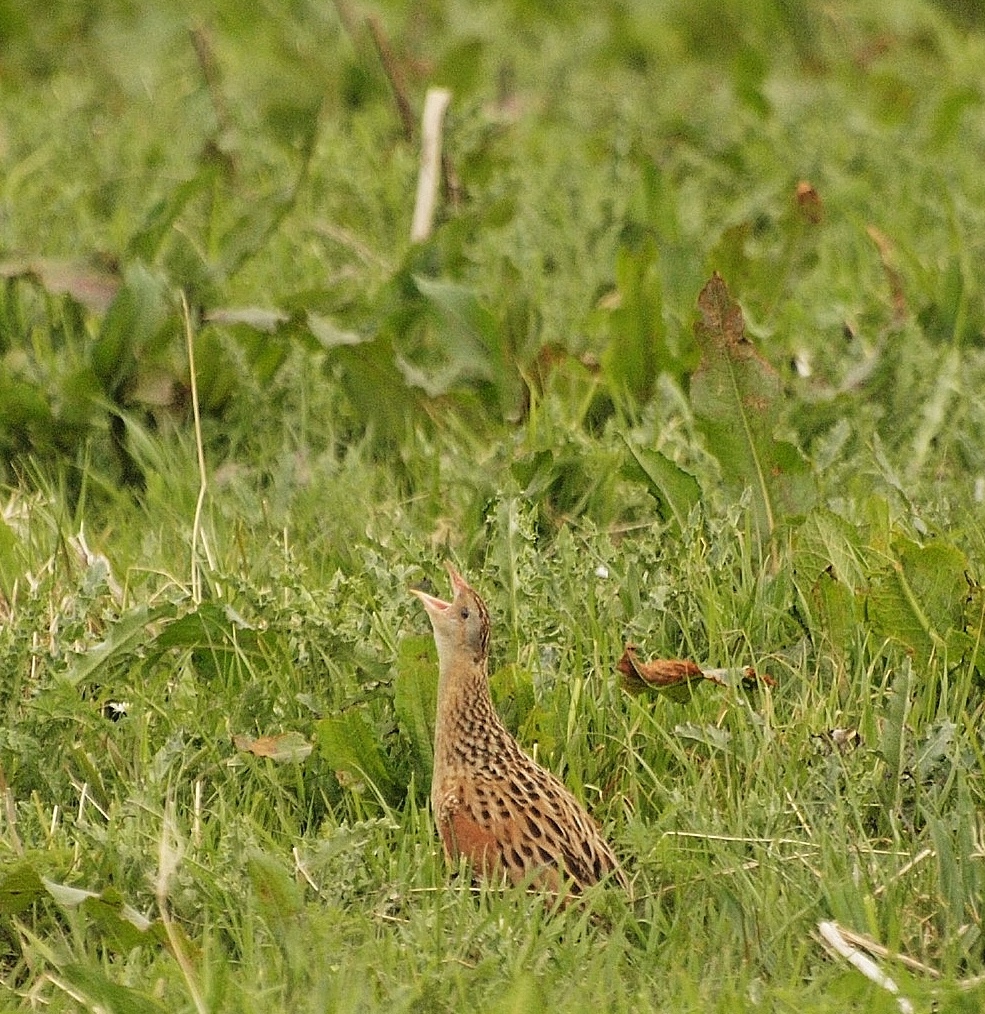
 
Corncake on Mull
Corncake on Mull
A recent comment left by a visitor said "that is the best £6 I have spent on this island this week , the birds were fantastic,  great views and very helpful knowledgable guides in John and Cheryl."

So don't miss out, come and see us soon ... 01680 812556

You can also comment via Trip advisor, we welcome your feedback.

Blogs posted by Colin Baxter on behalf of Mull Ranger Cheryl Callow


Tuesday, 28 May 2013

Our chick is doing well, whilst other wildlife make an appearance

The weather has greatly improved here on Mull and the single chick has grown to about 18 inches tall , very white and fluffy and can be seen from behind the food larder on the nest.

The female bird Iona is often sitting in the tree above the nest looking down on the chick and taking time out herself. The chick is regularly fed from the dead carrion, very delicately by Iona pulling off small pieces of meat from the bird carcasses and fish.

White tailed eagle with raven intruder
We have not seen the ravens like we did previously which caused concern for her and us all last week.

I reported that a grey and white bird that flew through the nest was confirmed as an osprey and it was with great delight that Alison Palmer who had visited the hide and drove off round Loch Scridain after leaving the hide had a very close view of it flying near this loch and being very adjacent to an oystercatcher, great photos Alison and a big thank young.

Osprey and oyster catcher over Loch Scridain
Osprey and oyster catcher over Loch Scridain - by Alison Palmer 

Also on Loch Scridain we have had many reported sightings of otters and was true for too for Alison too, another great shot.

Otter in the water at Loch Scridain
Otter in the water at Loch Scridain - by Alison Palmer

This is a magical island and if you love wildlife and photography then come to Mull and visit us at the hide.

five star wildlife experince we are in demand, so don't delay, make your booking on 01680 812556.

In the first week of June we hope to be ringing the young chick and also taking a genetic saliva test for future reference.

The concern about wildlife has been taken by a Wildlife Stock just published on 22nd may 2013 and we must all do our bit to keep our species healthy, the five partners on the Isle of Mull come together to protect the white tailed sea eagles and other wildlife.

We are part of The Green Tourism Award and I will be blogging shortly on what that means for us and how you can help us with our award, we hold a silver award at present and hope to improve on that.

I hope you have been watching The Herbride's on BBC Scotland which you can still get it on iplayer. Last Monday's programme showed the nest from Glen Seilisdeir and the birds ,Iona and Fingal, were at the forefront of the programme, such great photography, do watch if you missed it.

The groups of people visiting us this week has been on average about 25 and we have managed to get most people in the hide to get some great shots on smartphones, digiscoping and many other cameras of all shapes and sizes.  


Thursday, 12 July 2012

Ready, Steady, .......

Just a brief post on the latest at our Sea Eagle nest.  The larger of our two chicks is becoming more and more adventurous - much to the disgust of the other chick. 

On Tuesday  it spent most of the day flapping around the nest, strengthening the pectoral muscles to prepare it for flight.  At ten weeks old our chicks could fledge at any time, although we normally expect it to be nearer twelve weeks.  However, as we were finishing for the day the larger bird sidled to the edge of the nest and started to walk out to the end of the branch.  If have a feeling that it is only a matter of days before the larger bird decides to take off and explore.

But don't worry if you're coming to Mull.  The eagles will stay in the area around the nest for some weeks after fledging, and we'll ensure you have excellent views of the birds and their surroundings.

Please do come and see us soon. 

Wednesday, 20 June 2012

Drama at the nest

The Sea Eagle chicks are now seven weeks old and still growing rapidly. They are much more active on the nest now, pulling apart their own food when the adults are away although Iona still tries to feed them, tearing off tiny pieces of food as if they were still very small. Their diet has been very varied this week with fish, seabirds, pieces of a dead seal etc. and yesterday Fingal excelled himself by bringing in a mink. The chicks made short work of it but had to share it with their mother who is obviously very partial to mink.

We have yet to find out the sexes of the two chicks but, if I had to make a guess I would say that we have a male and a female as one chick is much bigger than the other and with only two days between hatching there would not usually be such a large size difference. The larger bird has already started standing on the edge of the nest and exercising its wings although it will be three to five weeks or more before it is ready to fledge. It's always a frightening time for those of us watching the nest when the chicks are wing-flapping as they stand right at the edge of the nest and it's a long way down if they slip.

Visitors at the viewing hide
Visitors at the viewing hide.  Photo Sue Dewar
Yesterday afternoon there was plenty of drama with the local Buzzard coming rather too close to the nest for comfort again. We can just hear the Buzzard chicks calling for food in the background, so the temptation for the adult to steal a piece of food from the eagle nest must have brought the adult Buzzard in.

It was not a good plan, though, as both adult eagles were at the nest and Fingal flew up, flipped over backwards with his talons in the air, and tried to grab the Buzzard. Although he didn't manage to catch it, the Buzzard got the message and took off with Fingal in hot pursuit. Our chicks are now much the same size as the Buzzard so we weren't worried that they were at risk, but the parent birds were outraged at the audacity of the smaller raptor trying to take the food that they had caught for their own chicks. It was an exciting time for our visitors and ourselves, but after half an hour everything had settled down and the nest returned to being a peaceful family roost.

Next week I am on annual leave so I can only imagine how much the chicks will have grown by the time I come back.


Tuesday, 15 May 2012

Peace reigns at Glen Seilisdeir

All is well at our Sea Eagle nest, and Iona and Fingal are the proud parents of two healthy chicks. They are almost two weeks old and are growing rapidly. At three days old we were already seeing wobbly, fluffy white heads bobbing about in the nest - now there are the first signs of grey showing through the white. The heads have stopped wobbling and are now expertly aiming for mum's beak - provided it is full of food!

To begin with Iona did all the brooding of her new family, with Fingal in charge of catching their food, but now both adults take turns. So far the chicks have been fed mainly on fish and seabirds such as Fulmars. To begin with the parent birds tore off tiny pieces of food to offer to their chicks, their enormous beaks bigger by far than the chicks' heads. With each day the morsels of food are getting larger and the chicks are getting greedier - it really isn't surprising that by eight to nine weeks they will be fully grown, and in ten weeks' time they will be ready to leave the nest.

As you can see by the photograph (taken for us by islander Alan Jack) the nest is very exposed, of necessity because with a wingspan of 2.4 metres the adults have to be able to spread their wings before launching themselves from the tree. You can just see Iona's pale head as she broods her charges on the nest.

To give you an idea of size the nest is about two metres across and just over half a metre deep, with a nest cup where the chicks lie and a built up surround so they are safe from falling. Over the last weekend the weather on Mull was atrocious and we were very concerned for the chicks' safety. Strong cold wind and heavy rain can be lethal for young birds and it was with some concern that we arrived on Monday to see if the nest was still intact with its precious contents. Thank goodness it was and as the weather warmed and the sun came out we were very relieved to see that all was well.

Last Friday we were visited by an assessor from the Green Tourism Business Scheme, and we are now awaiting our grading. All our power is provided from solar panels, and we strive to be eco-friendly in all that we do, so we hope that the assessor was impressed with what he saw.

The hide has been really busy, and everyone loves the new format. As the chicks grow we will see more and more activity at the nest, so if you are heading to Mull this summer do come to see us.

Friday, 4 May 2012

First white-tailed eagle chick hatches at Mull hide


White tailed eagle
Mull's White Tailed Eagles
The first white-tailed eagle chick of the year at the Mull Eagle Watch hide has been spotted by rangers.

It’s hopeful that a second egg is in the nest and that the proud parents, Iona & Fingal, will have another chick to look after in couple of days.

For the past 38 days, the adult birds have taken turns in incubating the eggs, sitting very low on the nest.

First indications that something had changed was on Tuesday this week when the female was sitting higher up on the nest. She was also fidgeting and fussing with the eggs so it was clear that a new arrival was coming.

Sue Dewar, White-Tailed Eagle Ranger with Mull & Iona Ranger Service said:

“We are thrilled to bits at the news and we are keeping our fingers crossed that all goes well with the remaining egg.

“It was on Wednesday afternoon that we first witnessed Iona, the female adult, bending her head down and gently feeding the chick.

“Tiny morsels of food were torn off by her huge beak and were delicately fed to her new chick. Iona was also very careful to keep her talons well out of the way so as not to put the chick in any danger.

”The new arrival is great news for the birds but also for Mull as so many people come to witness these massive and magnificent birds.”

Fingal, the male, was not seen during the afternoon the new chick arrived and was most likely to be off hunting to feed his new family.

If the female takes a break from her new duties the male adult will take over until she returns. If there is a second egg it could hatch in the next couple of days, as eagles lay eggs two or three days apart, but sit from the time the first egg is laid.

Dave Sexton, RSPB Scotland’s Mull Officer added:

“Whilst breaking out of the egg is one of the toughest parts of an eagle’s life, the next 10 days is also critical as they must be brooded by an adult at all times to avoid hypothermia. So Mull Eagle Watch and the CCTV will still be running 24/7 to ensure Fingal & Iona and their new family are not disturbed in any way”

Mull Eagle Watch is run by a partnership consisting of Forestry Commission Scotland, Mull & Iona Community Trust, RSPB Scotland, Scottish Natural Heritage and Strathclyde Police.

Part of the income from trips to the hide is put into a fund which is available to the islanders for local community projects. A recent survey reported that the white-tailed eagles alone bring in £5m annually to Mull’s economy, which is hugely important to the island.

All over the island, Mull Eagle Watch’s dedicated team of volunteers have been watching the eagles’ nests to ensure that no-one gets too close as the birds will leave the nest if they are disturbed by anyone – deliberately or inadvertently.

Because the Mull Eagle Watch are constantly on the lookout for egg thieves, nests are watched for 24 hours a day and this year CCTV is also being used with other high-tech equipment to back up our volunteers.

Once the chicks are hatched there are still problems from the very occasional photographer who wants to get closer than is comfortable for the birds, and two such people were prosecuted last year for ignoring instructions not to go too close. Fortunately on that occasion the chick survived, but only because volunteers and police reacted quickly.

The hide at Glen Seilisdeir is open Monday to Friday from April to the end of September, running two trips a day. White-tailed eagle rangers will tell the story of the eagles’ extinction and subsequent reintroduction, and then escort visitors to an outdoor viewing hide just 300m from the nest. Booking is essential on 01680 812556.

Wednesday, 2 May 2012

Have they, or haven't they?


white tailed sea eagle
Sea Eagle in flight - photo courtesy of Alan Jack
 This week we are playing the waiting game. Our egg(s) are due to hatch any time now and everytime the on-duty adult stands up on the nest, we wait with baited breath to see a tiny, wobbly white head, or the other adult bringing in food.

Yesterday afternoon the weather was superb (as it has been for over two weeks now), and the conditions were perfect for a precious Sea Eagle chick to come into the world. But the adults seemed to be just turning the eggs and then settling down to incubate again.

Maybe they could hear the first chick cheeping inside the egg as it started to break its way out using the tiny egg tooth on the top of its beak. Or maybe not! Eggs can easily take 36 hours to hatch, so, like Iona and Fingal, we must be patient and wait for that first feed!

We can't help thinking back to last year, when the beginning of May saw horrendous winds sweep the west coast of Scotland, and the eagle nests were all checked the next morning. We were convinced that at least one nest tree would have come down, but no, everything was intact and Mull's Sea Eagles successfully fledged 11 chicks in 2011.

We suffered even stronger winds over the winter months with one gust on Mull recorded at 165 mph. Surely some of the eagles would have to build new nests this year to replace those damaged? Sea Eagles are obviously better nest builders than we give them credit for as most nests survived. One nest did collapse and the following day the eagles there carried out a hurried repair job - only for the winds to return and the new nest be blown out of the tree too. But Sea Eagles are resilient birds and it's always surprising to see how quickly they put their nests together.

The new "wild hide" - photo courtesy of Alan Jack
Our new viewing hide, set into the woodland, is proving a huge success. Everyone says they feel closer to nature, and the smell from the pine trees is all-pervading. The shading at the front of the hide means that the eagles can't see us although they know we are there.

Occasionally they will hear something and if we happen to be looking through a telescope at the time we see a beady pale lemon eye staring back at us.

With luck we will soon be watching food being brought in for the chick(s) by the parents, and then tiny slivers will be torn off and fed tenderly to their offspring. I wonder if we'll have a hatching today?

Tuesday, 7 July 2009

This year's chicks


This great picture is the first image of this year's sea eagle chicks. It was taken by Alasdair Cameron, Wildlife Ranger Manager with Forestry Commission Scotland, during the birds’ ringing. See a larger version of the image.


Wednesday, 1 July 2009

One down, one to go

On Friday morning I was watching the nest with a group of visitors. Both chicks were there and one was very active, flapping its wings and preening. This wasn't unusual and when I took the afternoon trip down to our forward hide I expected to see something similar. But no, there was only one chick. I scanned the branches around the nest to see if the chick was there. Nothing! Later, Skye, the male Sea Eagle appeared sitting in a larch tree well below the nest. I'd never seen him there before, and he seemed to be looking down at the ground most of the time.

The other chick seemed to be quite happy by itself on the nest, alternately exercising and feeding. I stayed on at the hide after the visitors had left, but eventually I had to leave, albeit reluctantly. Skye remained in position, but there was still no sign of the missing chick.

Saturday came and went with good views of Frisa and the chick in the nest, but still there was no sign of the "fledged" chick. Wherever it was, it seemed likely that Skye was watching over it as he didn't put in an appearance all day.

By Sunday we were beginning to get quite worried, and on Monday when there was still no sign of our fledged chick we were beginning to fear the worst. It was my day off, but I couldn't stay away - I was desperate to know if our chick was still alive. Maybe it had fallen and injured itself. Skye still hadn't appeared so we were hopeful that he was guarding his chick.

On Tuesday morning I arrived at the hide early and put up the scope to scan the trees around the nest. The visibility wasn't great, but there, at the top of one of the sitka spruce trees was a strange dark shape. Zooming in I realised it was our chick. It was sitting very awkwardly with one wing at an angle to its body. If this had been its first proper flight it obviously needed to practise its landing skills. I couldn't tear myself away - was it our chick? There was no white on its tail, no flash of yellow on its beak. I was sure it wasn't one of our adults, but struggled to convince myself that I was really seeing the fledged chick. The other chick was still on the nest, and seemed quite happy exercising and feeding on whatever delicacy the adults had brought for it.

When I arrived back at the hide with the first trip of the day I checked the scope - the fledgling had gone. It didn't appear for the rest of the day, and I was beginning to doubt my earlier sighting. Later in the afternoon the RSPB officer Dave, who holds a licence which allows him to get closer to the nest, spent some time in the woods below the trees and after a while managed to hear two chicks calling, one on the nest, and one further away. Whilst he was there Frisa, the female came in and landed.

The fledged chick hasn't put in another appearance yet, but at least we know we still have two chicks. We haven't seen Skye either, so he must be perched near the fledgling making sure it is safe and well fed. The chick's sibling is still on the nest making the most of the extra space, and being able to eat as much as it likes without having to share.

I can't say we're relaxed about the fledgling yet, but Frisa seems to be her normal self, and we have heard no alarm or distress calls from adults or chicks. Watch this space.....

Wednesday, 13 May 2009

Sunshine and an Osprey!

Well, this week we could be in a different country. The torrential rain and gales have blown through and we have had the most wonderful warm, sunny days.

The eagles have been working hard to feed their rapidly growing chicks and we have had some wonderful views of both adults flying right overhead giving some spectacular displays. When the sun catches the white tail our visitors are awestruck.

The chicks are much more active this week at almost four weeks old, and are beginning to try to pull their own food apart. Their antics are quite amusing when they both have the same piece of food, with one of the youngsters often falling over backwards.

Whilst our party was split between the top and forward hides on Monday we had a fantastic view of an osprey flying through. Ospreys don't nest on Mull, but every year we have at least one bird turning up on the island and maybe one year we will have a pair who decide to stay. Our bird gave us a lovely display circling low over the loch before flying southwards.

We've also had a juvenile Golden Eagle floating around above the hide - not getting too close to the nest, thank goodness, but giving our visitors a great opportunity to see the difference in wing and tail shape between Golden and Sea Eagles.

As I write the sun is still shining - long may it last!

Tuesday, 21 April 2009

Wonderful news!

I'm delighted to say that Skye and Frisa are proud parents!

We're not sure how many chicks they have, although we suspect two, but we have had some wonderful views of Frisa tenderly feeding her offspring.

It always amazes me that such a large bird, with feet almost as big as my hand, can tear tiny pieces of food from the prey and gently place it into her chick's beak - a beak about the size of your fingernail.

Skye is busy playing the proud father and has chosen a roost very close to the nest tree so that he can guard his new family when he is not out hunting for them. Frisa spends her time rearranging the nest bowl so that it is comfortable for her chick(s) before settling herself gently down to keep them warm. Today the weather was cooler and there were some very heavy rain showers, so she was brooding her young very closely, but she did allow herself a little time away from the nest. As soon as she was certain that Skye had taken over in the nest, she did a small circuit before flying right over our hide - as if to tell us all the good news.

The adult birds will be very busy for the next few weeks, bringing in ever increasing amounts of food for their family. By eight weeks of age the chicks will be fully grown - an incredible growth rate - and they will spend the last three or four weeks growing their flight feathers to their full length and practising wing exercises on the edge of the nest. At around twelve weeks the chicks will be ready to fledge and the adults will be trying to encourage them to fly by perching in a nearby tree with food until the youngsters take that plunge into the unknown.

Skye and Frisa are not the first pair of Sea Eagles on Mull to hatch their chicks this year. You might remember the publicity in the press last year when a photographer got too close to another nest on the island, forcing the female to leave her eggs for well over an hour. The eggs chilled and failed to hatch and the photographer was charged with reckless disturbance and fined £600. This year the eagles built a new nest and last week their chicks hatched, so everyone is delighted.

Skye, who is 15 years old, and Frisa, 17, have been nesting on Loch Frisa for eleven years now, so they know their territory well and this year's nest is well positioned to keep intruders away. They are still harassed by the local Ravens, buzzards, Hooded Crows and Golden Eagles, and even the occasional juvenile Sea Eagle flies a little bit too close to the nest, but you can rest assured that both birds will guard the nest with their lives.

There will be plenty of activity over the weeks to come, so if you can get to the hide we'll be delighted to tell you all about it. If you can't make it to Mull this year keep watching the blog and I'll do my best to make you feel as if you are here with us.