Showing posts with label White-tailed Sea Eagles. Show all posts

Monday, 22 July 2013

Our chick is desperate to get up in the air!

We have had a mixed week of weather from sunshine to mist to rain and the chick has sat through all of this and at the same time wings flapping like mad !


During this week there has been a very International flavour at the hide with visitors from Wisconsin USA, Australia and families from from Austria & Germany.

Our male bird Fingal has been around a lot more this week flying in with food at regular intervals. Many small gosling have been eaten and often the nest if covered with white fluff and feathers! When Fingal lands on the nest, its like a hover craft coming in and blowing all the feathers up in the air, a sight to behold!

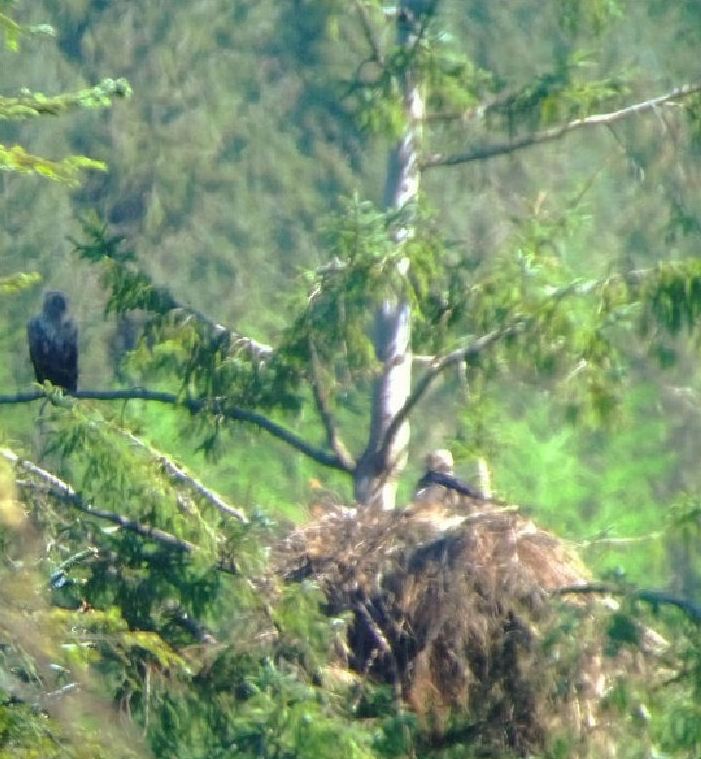
Iona watches over her chick at the nest

Iona has been sitting on the branch very close to the chick, to the right as you look at the nest. On Thursday, she sat there for five hours without flying off!

The hide will be open all summer until the end of August as the chick will stay in the area and they often come back on the nest for about a month, so please still come and see us.

Once the chick has fledged we will walk you through the Glen to observe all three birds.
Booking is a must and can be done by calling 01680 812556 or visit forestry.gov.uk/mullseaeagles for more info.

Blog published by Colin Baxter on behalf of Cheryl Callow, Mull Ranger

Monday, 15 July 2013

Glorious weather on Mull - great for eagle viewing trips!


Parents and chick all at the nest together
I returned from a few days off to find the chick nearly fully grown. It is very big  and beautiful.

There is much wing flapping and many poo’s over the side of the nest! John and I have gasped many times when she does this and we think we should have safety around the top of the nest next year!

In the early part of the week all three birds were on the nest, a rare sight.

We have had some wonderful guest to the hide including wild life.I was helping an elderly couple view the Eagles near the hide with their daughter when a dragon fly came down and landed on my brand new van.

The colour of it against my very clean van stood out. It was a golden moment we both stood still and took pictures and marvelled at nature and its beauty.

The weather has been excellent with wall to wall sunshine, but in the morning we have been having a sea mist. The same day I was at the hide with the elderly couple and the dragon fly, I had to go off for five minutes to check some mist/smoke that was rolling in. It was sea mist and when I drove down the drive away from the hide it had  dropped 6 degrees in temperature.

The next day we had a group of gentlemen from Israel visit us. Also in the group were Lyn and her mum Dorothy. During this visit, a parent bird came in with a large object. Dorothy asked to see the back play on one of the Isreali gentlemen's cameras and we all saw it was a large fish they had brought into the nest which the chick eat straight away…. Great shot, great timing .. thank you Dorothy for asking ……

It was a small group that day, but plenty of questions were asked, whilst there was lots of camera activity, which was so fast it sounded like ticker tape off the old teleprinter machines , if you remember them !!!

I met Lyn and her mum again yesterday on my ranger walk at Calgary where I had 22 people. It was a stunning day of weather and we had great fun.
 
Well I must go to the hide. John is off today and I am on my own so I will have some private moments with the chick on the nest to cherish. What a privileged job I have helping the public see this rare bird , speak soon……

If you have not visited us yet, or your back on the Island do come and see us, we run trips at 10am or 1pm. If you are passing at these times and you have not booked, just check with us at the lower car park.

To book please phone 01680812556. Just to note, we are at the South of the Island at Glen Seilisdeir and not at Loch Frisa as in year's previous.

Blog published by Colin Baxter on behalf of Mull Ranger Cheryl Callow.

Friday, 5 July 2013

Our chick is nine weeks old today!

The chick is nine weeks today and is growing very fast.
It’s been amazing to watch the female Iona, who has been bringing in afterbirth from seals.
I have now seen this three times, it’s been a bit messy and Iona’s tail has been blood red instead of white!
The chick has been eating it very much like a piece of elastic at times, pulling up on stringy pieces of flesh like material.

I spent a private half hour on Friday on my own at the end last week, watching this wonderful sight. The feathers of the chick were drying out, after a morning of rain, and then sea mist. The feathers were just fluttering, in the slight breeze, so delicate to watch.

Our growing chick flapping
it's wings

The sharp beak is working well, and the chick is feeding itself. I realised that I have become very fond and very attached to this wonderful chick. What an honour it is to be able to watch this beautiful bird grow up.
My heart is in my mouth every time it flaps it's wings, building up its strength. It tends to move to the back of the nest and very close to the edge, if it was to fall out now it may not survive and could spell disaster!

I have got to say the groups that have been in the last week have seen some great views of the wings flapping. I am keeping my wings crossed that when I return from my holiday the wee young bird I have given the name 'Friday’s Chick’ will be safe and well. The chick will be named formally soon by a local school.
We are still waiting to hear what gender it is.

I thank every one who has visited us so far this season and thank you for all your emails, blog comments and trip advisor entries.

Please keep coming to see this wonderful chick and parents. John Clare ,the RSPB Ranger will be there ready for you. He likes chocolate and do laugh at his beak joke!
Bye for now Cheryl back on Monday 8th July 2013.
To book now please phone on 01680 812556

Blog published by Colin Baxter on behalf of Mull Ranger Cheryl Callow

Wednesday, 22 May 2013

An abundance of wildlife in and around the hide

White tailed eagle nest on Mull
After a weekend of rain, the week started with yet more and the concern that the only chick had survived the conditions.

The beginning of the week saw Iona staying on the nest and Fingal bringing in sea birds as the main food source .

In the nest we saw Fulmars , Gulls and a female Eider duck stored around the nest edge .

From behind the food larder we could see one small wee fluffy white head popping up now and again. With the male bird keeping guard .

The road to work was very dramatic and at Gribun it has been spectacular with the clouds rolling in .

The reception hide has seen numerous siskins on the feeders in their bright colours . We are still waiting to capture a photograph of the Scottish crossbill .

Otters on Mull
Otters on Mull


The wood itself has some amazing views in both directions. On the walk to the west and then also, off to the east along a track, affording a view high up where there has been a new track established which shows the forest to us all .

Around the Loch nearby there have been sightings of short eared owls and otters captured by John Clare the RSPB ranger .

On Thursday we had the George Watson College attend the hide and they had a wonderful visit that included building the WTE nest demonstrated in the photograph attached - well done and come back soon .

Constructed white tailed eagle nest


Monday, 13 May 2013

Mull - a bird spotters paradise and maybe another chick?

Last week started off with thoughts of possibly two chicks in the nest. Monday brought heavy rain and Iona sat on her nest for most of the day protecting her brood. Tuesday came bringing sunshine and we were able to see the head of one small chick.

Iona at the nest with chich just visible behind

 I was able to take some photos of both Iona and Fingal on the nest, which is now becoming full of various carrion such as Gull, Fulmar and rabbits. This pair of WTE are known for taking sea birds based on previous research when cleaning up and analysing the content of the nest at the end of last season.
On Wednesday we had mixed weather and had large groups at the hide, who were treated to some action in the afternoon, when what was described as a grey bird flew in past the nest.

Rainbow over Loch Na Keal

The nearby Ravens were also making a lot of noise. I went off for 10 mins to go and see what was going on. I saw a large bird sitting off down the Glen towards Loch Scridain but could not identify it.

I came back and reported this to the group and John Clare the RSPB ranger. Later that day four very keen gentlemen birders left the hide and subsequently reported seeing an Osprey on Loch Scridain. Ospreys are infrequent visitors to Mull so this was a great spot!
Thursday continued with yet more well attended groups including some new honeymooner's - we have had seven couples now so far this season.

On the way to work yesterday I saw a wonderful rainbow over Loch Na Keal and on the way home, I caught up with the four gentlemen who had spotted the Osprey on Wednesday. On this occasion they were watching three Golden Eagles over Ben More. They reported seeing so much wonderful wildlife during their week on the island and this was now their fourth consecutive year visiting Mull.

Friday, 3 May 2013

It's a waiting game for the appearance of eagle chicks here on Mull

This week has been a very quiet week at the hide and we are playing the waiting game .

Our eggs are due to hatch any time now and everytime the adult bird on duty stands up on the nest we are waiting to see if the chicks have hatched!

The weather this week has been very mixed and the last three days have seen heavy showers and the temperature dropping to 4C which is quite cold.

The adults seem to be just turning the eggs and settling down to incubate again. Eggs can easily take 36 hours to hatch so we must all be patient and wait and see. John and i will be watching for any change in behaviour around the adults.

Last year the Mull Sea Eagles successfully fledged 19 eagle chicks with a total of 60 on the west Coast of scotland.

Our view from the hide is from the forest directly in front of the nest at a safe distance so as not to disturb the birds. Within the hide you get some excellent views of the nest and you feel close to nature, with the smell of the pine and clean air. It give you the ambiance of being close to the Eagles. The shaded area of the hide that you look out from gives great protection from disturbing them.

Some of our visitors in the hide

As you look out at this enormous nest you cannot help but feel privelaged to witness a very rare bird that has been reintroduced successfully into it's natural habitat.

Occassionally we hear the call of the male eagle Fingal as he does a fly past just before a change over on the nest or whilst roosting on a tree near by.

Iona the female eagle often looks up to the sky, with that beautiful large golden eye, keeping a check on Fingal and any one else close to the nest.

This week we have not seen any extra birds brave enough to fly into the nest like last week!

I hope to have some good news for you all next week on our eggs/chicks. Finger crossed for a good weekend.

Monday, 29 April 2013

Visitors from far and wide, come to visit the Eagle Hide!

Easter week came and went bringing with it many visitors to The Eagle Hide. During this time, Fingal and Iona have been keeping their eggs incubated and whilst doing so, have witnessed a number of visitors to their tree! These brave birds have included a Great Spotted Woodpecker which flew in and landed right on the top of the tree, a Hoodie on a fleeting visit and then last Friday, a Siskin even perched right on the edge of the nest. Our eagles were very tolerant and just sat there, appearing to admire the incomer.

The week after Easter we had visit from a lovely family from Conneticut in the USA. Their parents had lived on the Isle of Mull, Mark and Fiona Eden-Bushell, whose daughters were former pupils at Bunessan School.

U.S visitors to the Mull Eagle Hide
Our U.S visitors with Mull roots
  One of the daughters was named after the island of Iona and was with Marie, Jason and Calum. The other family members were Lucetta, Angus, Maggie and Grant.

They brought with them good weather on the day of their visit and it was lovely to see young people thoroughly enjoying their roots and heritage. Thank you for visiting us at the Hide and I hope I got all of the names correct!

The following week brought in plenty of rain and wind. I was a little worried about Iona on the nest but she sat right through the hard weather, determined to keeping those eggs protected and warm.
We had yet more great people at the Hide despite the conditions and Stu Darby was very helpful, sending me some lovely photos of the ‘changeover’ during the week of 15th April.


The changeover. Image by Stu Darby
 This was when Fingal flew in and the pair did some very careful manoeuvring around the nest with their talons turned in so as not to damage the eggs. This is always a very delicate operation and just amazing to watch.

During the week of the 22nd April some agricultural students, a group of Scottish Forest Rangers and Laurie Campbell, a Wildlife Photographer, visited us. It was a delight to meet all these wonderful people and to exchange wildlife tips, information, experiences and stories. The agricultural students were particularly complimentary about the Eagle Hide and staff.  


Iona and Fingal at the nest.
Image by agricultural student Claire Holland
 I was privileged again to see another changeover whilst on my own on Thursday and just before the group in the afternoon arrived.

On Friday a young couple, on holiday from Northern Ireland returned for their second visit of their stay and were lucky enough to share their morning with Laurie Campbell. He was there specifically to photograph the Eagles and the people visiting, for an article he had been commissioned to do in relation to Camper vans. What an honour to have him in the Hide.

I got plenty of tips about wildlife photography and he proved to be a very caring, sharing person who was clearly a consummate professional.
His patience and determination were second to none and both John and I left him on site mid afternoon on a cold grey day, sitting tight and prepared to wait for his shot until early evening. The Eagles had changed over with the male hunkered down and as I made my way back to the office, I saw the female flying out over the woods.

What will the week of 29th April bring? If you are coming to the Isle of Mull please come and find us.

Call us on 01680 812556 to avoid disappointment. We look forward to seeing you!

Tuesday, 16 April 2013

Visitors young and old enjoy spectacular eagle sightings at our wildlife hide

Sea Eagle courtesy of Mark Blake Nottinghamwildlife.comIn the first three weeks of the season, glorious weather has helped give visitors spectacular views of the nest and birds, from the viewing area that enables a close encounter with these majestic creatures. 

Positioned amongst the trees, the viewing area allows clear sightings, while providing enough cover to prevent disturbance of the nesting birds. 

Numerous people, varying in age from young children to people in their eighties, have watched the birds. There have already been visits by three honeymoon couples, our local MP, and the Environment Minister who presented a £ 6,261 cheque to Mull and Iona community groups, comprising the money raised from Mull Eagle Watch in 2012.  This brings the total to well over £ 50,000.

Many excellent photographs have been taken and reactions and feedback from all the visitors has been tremendous, with one man in his 60’s, who has been trying unsuccessfully to see an eagle for over 20 years, in tears.  Memorable moments so far have included the interaction of both adult birds on the nest with much rearrangement of nest material and calling. 

The presence in the sky above the nest for a short while of an ‘intruder’ white-tailed eagle juvenile from the east coast of Scotland also lead to much vocalisation, while the arrival at speed of a female sparrowhawk in the viewing area almost lead to agitation of a different kind.  Other highlights included close views of a treecreeper’s antics delicately picking insects from adjacent tree trunks above visitors heads and regular visits of a friendly robin, which kept everyone entertained.

All is looking well for an excellent season and we hope to post a range of images taken at the hide this year over the course of the next few months.

Thursday, 28 March 2013

Mull Eagle Hide now open for 2013


Our first visitors of 2013 ready to enjoy their trip to the
Our first visitors of 2013 ready to enjoy their trip to the
eagle hide at Glen Seilisdeir 

The wait is finally over and the Eagle Hide on Mull is now open for the 2013 season.

The first visitors arrived on Monday 25th March and were joined by John Clare, the RSPB Ranger and Cheryl Callow, the Seasonal Ranger for the island.

The weather has been kind to Mull over the last year and although it has been cold we have not had the weather that has hit the Isle of Arran and Ireland.

Bookings to visit the hide are a must and you can reserve your place by calling 01680 812556. The trips will  run daily from Easter weekend to October and last approximately 2 hours, subject to availability.

Costs are Adults £6 (including RSPB members), under 16’s £3. Trips to permanent Mull residents are free.

Both Fingal  and Iona the resident White Tailed Sea Eagles are ready and waiting to greet you at the nest.

We look forward to welcoming you to Mull.

Tuesday, 11 September 2012

A great year for our white tailed eagles at Mull Eagle Watch


White tailed eagle
After a fantastic season the Eagle viewing hide at Glen Seilisdeir is now closed. Iona and Fingal successfully fledged two chicks, and the family can still be seen in the area.
However, there are still plenty of opportunities to view White Tailed Eagles around the island. The eagles don’t migrate and can be seen hunting for fish and seabirds over the lochs and sea, as well as looking for rabbits or hares inland. During the autumn the young birds tend to congregate together, sitting in trees or on the ground near to the coastline, whilst the adult birds will stay in and around their home territory.

Mull is not known as “Eagle Island” for nothing, and hosts one of the highest density populations of Golden Eagles in Europe, although these shy birds are more difficult to see as they keep well away from people.

If you are struggling to tell the difference between the two species, the adult White Tailed Eagle (the fourth largest eagle in the world) has a wingspan of 2.4 metres, stands about a metre high and weighs in at 7 kilos. It is a light brown colour with a paler head. When flying its broad wings are held in a flat profile and the adult’s white tail is short and wedge-shaped, leading to it being referred to as a “flying barn door”. The juvenile eagles are a dark, chocolate brown colour all over and don’t have the white tail initially, with those feathers moulting in over the next four or five years until it is ready to breed.

By comparison the Golden Eagle has a wingspan of around 2 metres and is a golden brown all over. It holds its wings in a shallow V-shape when flying, and is often seen flying high over the hills “hugging” the ridges whilst it searches for prey. Its tail is rectangular in shape and longer than the Sea Eagles. Juvenile Golden Eagles have white patches under its wings and a white rump at the top of its tail. They feed mostly on mammals and birds but are much more difficult to see than the White Tailed Eagles which are often seen perched in trees or on rocks.

If you see a large brown and cream raptor hanging in the sky (as if hovering) it will not be an eagle. Buzzards and Hen Harriers do this, but the eagles’ body weight is too high for their wings to support hovering.

The eagle hide will remain closed during the winter months whilst this year’s youngsters gradually moving away from their parents and, come December, the adult birds will start looking for nest sites or maybe adding to existing ones. Come February their courtship rituals will begin and by March they will be ready to start nesting. The birds are heavily protected under the Wildlife and Countryside Act, and at this time they are very sensitive to disturbance.

Watch this space for information on where and when the 2013 hide will be opening or visit our web pages.

Tuesday, 28 August 2012

An empty nest, and all's well at Glen Seilisdeir


Adult Sea Eagle being mobbed by a Hooded Crow
(Photo: Sue Dewar)
 Firstly, my apologies for the gap between postings. The last couple of weeks has been hectic to say the least and I’ve barely been in the office.

The good news is that our second chick finally left the nest just over three weeks after his sister. To begin with the female chick kept returning to the nest as the adult birds were still feeding her brother there, and if the adults weren’t around she continued to bully him and snatch his food.

Thankfully, Iona was usually on hand to see
fair play, and eventually her daughter discovered that she could fly just as well as her parents and began to concentrate on following them and learning to hunt for herself. She has given us some great displays but the highlight was one day when both adults and the female flew together over the forest and up towards Ben More, getting higher and higher until the three of them were just dots in the sky. A cheeky Buzzard mobbed the young female relentlessly but she was having none of it and managed to shake him off.

Once the young male was allowed to eat his food in peace he really started to fill out, his tail and flight feathers grew down properly and he began wing-flapping exercises to strengthen his muscles ready for his first flight. Sadly we weren’t around when he finally took off, but the following morning we could hear him calling from somewhere in the forest and after a few days he proved that he too could fly when he appeared back on the nest. The adult birds occasionally bring food in and leave it there (and it doesn't take long for the chicks to find it), but most of the time they are trying to encourage both fledglings to follow them and learn how to hunt for themselves.

After the wonderful weather we have had on Mull this summer, yesterday we had torrential rain and strong winds and when I went to the hide I was relieved that the chicks had fledged as they would have been wet and miserable sitting up there exposed to the elements.

With the Scottish children back to school now I can now tell you that Bunessan Primary School (whose turn it was to name our chicks) decided to call the young birds after their school colours. So our young male is Gorm (pronounced Gorum) which is Gaelic for Blue, and the female is Buidhe (pronounced Bweeya), Gaelic for Yellow. Both chicks will stay in the area with Iona and Fingal for several weeks yet, perfecting their hunting and flying skills before eventually exploring the rest of the island and beyond. For a while they may enjoy the company of other young Sea Eagles fledged on Mull this year; in the autumn we often see groups of them perched together like a Sea Eagle youth club! Then they will begin their four-year journey of discovery, each year their tail feathers becoming whiter, their beaks turning yellow and their body and head feathers becoming paler, until at five years old they will look just like their parents. At that stage they will be searching for a mate and a territory of their own - who knows where they will end up?


This is our last week at Glen Seilisdeir - the hide closes on Friday 31st August as essential logging operations begin in the forest on Monday. It has all gone far too quickly, but it has been a real privilege to watch Iona and Fingal incubate their precious eggs through to hatching, and to watch Buidhe and Gorm grow from wobbly four-inch high, fluffy white chicks to full-grown magnificent Sea Eagles. Over the next few days I will gather together all the images that I (and others) have taken at the hide and post them on my final blog for this year.

Monday, 30 July 2012

Now you see her, now you don't!

Well, last week saw some interesting goings on at the Sea Eagle Nest. Previously I reported that our largest chick (thought to be a female) fledged from the nest leaving her smaller sibling to spend time putting on weight and growing down his(?) last flight feathers before fledging himself. All seemed to be normal with food being brought into the remaining chick by the parent birds, and it appeared to be putting on weight and growing apace.

And then, on Wednesday the older chick suddenly appeared back on the nest, much to the surprise of its sibling. Not only that but it stayed throughout Wednesday and Thursday. This is unusual behaviour, as once the birds fledge it is unusual for them to return to the nest. Our theory is that the older chick worked out that the adults were feeding its sibling, therefore there must be food at the nest. Sure enough, the first time the adult male came in with food for the smaller chick (a large, wriggling eel), the fledgling shoulder-barged it out of the way and grabbed the food for itself. As before, the small chick immediately retreated to the other side of the nest, once again intimidated by its sister. However, this time the fledgling failed, as in her haste to grab the prey it escaped and fell onto the side of the nest where it was grabbed again by the adult male who quickly swallowed it whole.

Soon after the female came in with what looked like a Fulmar and delivered it straight to the smaller chick whilst blocking the fledgling so that her brother could eat in peace. Both adults then remained at the nest for the rest of the day, mediating between their chicks. After I'd left the hide one of the adults must have brought in a rabbit, as the following morning the smaller chick was pulling at the remains of a rabbit leg; who knows which chick got the lion's share of that meal!
Fingal with food for a hungry young eagle
Photo by kind permission of Chris Stone
 The following day the whole scenario was repeated, with at least one adult around to see fair play, though later in the day they both took off, presumably to hunt for themselves, and although I stayed at the hide until gone 9pm neither of them returned to the nest. Both chicks were at the nest all day, but my colleague - FCS Wildlife Ranger Steve Irvine - reported that on Friday only the younger chick was there with an adult visiting the nest and then sitting higher in the tree keeping watch. Maybe the older chick got the message that trying to steal food from her sibling was not to be encouraged by her parents.


The chicks are now a little over twelve weeks old and it won't be too long before the second young eagle fledges. I can't wait to watch them learning to fly strongly and hunt for themselves - with a little help from their parents, of course.


Wednesday, 20 June 2012

Drama at the nest

The Sea Eagle chicks are now seven weeks old and still growing rapidly. They are much more active on the nest now, pulling apart their own food when the adults are away although Iona still tries to feed them, tearing off tiny pieces of food as if they were still very small. Their diet has been very varied this week with fish, seabirds, pieces of a dead seal etc. and yesterday Fingal excelled himself by bringing in a mink. The chicks made short work of it but had to share it with their mother who is obviously very partial to mink.

We have yet to find out the sexes of the two chicks but, if I had to make a guess I would say that we have a male and a female as one chick is much bigger than the other and with only two days between hatching there would not usually be such a large size difference. The larger bird has already started standing on the edge of the nest and exercising its wings although it will be three to five weeks or more before it is ready to fledge. It's always a frightening time for those of us watching the nest when the chicks are wing-flapping as they stand right at the edge of the nest and it's a long way down if they slip.

Visitors at the viewing hide
Visitors at the viewing hide.  Photo Sue Dewar
Yesterday afternoon there was plenty of drama with the local Buzzard coming rather too close to the nest for comfort again. We can just hear the Buzzard chicks calling for food in the background, so the temptation for the adult to steal a piece of food from the eagle nest must have brought the adult Buzzard in.

It was not a good plan, though, as both adult eagles were at the nest and Fingal flew up, flipped over backwards with his talons in the air, and tried to grab the Buzzard. Although he didn't manage to catch it, the Buzzard got the message and took off with Fingal in hot pursuit. Our chicks are now much the same size as the Buzzard so we weren't worried that they were at risk, but the parent birds were outraged at the audacity of the smaller raptor trying to take the food that they had caught for their own chicks. It was an exciting time for our visitors and ourselves, but after half an hour everything had settled down and the nest returned to being a peaceful family roost.

Next week I am on annual leave so I can only imagine how much the chicks will have grown by the time I come back.


Thursday, 14 June 2012

What - no food mum?

Another busy day at the eagle hide with the parent birds, Iona and Fingal, putting in more appearances at the nest than of late.  Yesterday we didn't see very much of our adults but they must have been busy hunting, as all sorts of food could be seen on the nest, including the intestines of a fairly large mammal which the chicks proceeded to play tug-of-war with whilst we were trying to eat our packed lunches!

Today the adults have been backwards and forwards to check on their youngsters, and probably to see how much food was left uneaten.  It would appear that there wasn't very much as Iona and Fingal have spent a lot of time out catching food.  This afternoon the female brought in a fairly large white bird - probably a gull - which she insisted on plucking before letting the chicks start to eat.  The local Buzzard was showing a lot of interest in the nest too, prompting the adults to return frequently to persuade it not to come too close.


The six-week old chicks on the nest with Iona nearby
Photo: Sue Dewar
 When Iona flew in late this afternoon she had a quick check on the nest to satisfy herself that all was well, before flying to a nearby branch.  It was easy to see the chicks' disgust as they tottered around on the nest searching for food. Eventually, they decided there was nothing much to eat and settled back down for yet another snooze. 

And a final note - we heard today that our White-tailed Sea Eagle family at Glen Seilisdeir will feature on tonight's final episode of Springwatch, starting on BBC2 at 8pm.                                                                                                                                                                                                                                                                                 

Monday, 11 June 2012

Mull Sea Eagles go green (and silver!)

Following our recent assessment for the Green Tourism Business Scheme (run by Visit Scotland), I'm delighted to say that we have been awarded a Silver award for the Eagle Hide. I'm told that it is not often for a Silver to be awarded at the first attempt so we are very proud.

Although we don't need to generate much electricity, our TV monitor and CCTV camera with all the attendant wiring are run from our bank of solar panels, and we have the option of a small wind turbine if we need any further power.

Over the last two weeks we have been visited by primary school children from all over the island and they have had a great time watching our rapidly growing chicks on the nest, learning the story of the White-tailed Sea Eagles and impressing us with their own knowledge of the eagles and other birds of prey on the island. Before going to the viewing hide the children built a life-size eagle nest out of branches, twigs and sprays of foliage collected from the forest.

Lochdon School sitting on the nest frame
Lochdon School sitting on
the nest frame before building

The children had great fun building the nest and all were surprised at the size of nest needed for the adult Sea Eagles and their rapidly growing offspring. Iona and Fingal's nest is about 2m across by 0.75m deep, and is extended every year the birds use it. By the time the children got to see the eagles through our telescopes they had realised just how much work the adult birds had to do before they could lay their precious eggs.
 
The hide continues to be as busy as ever, and our two chicks are now five weeks old. Both are doing well, and I hope to have more news of them when they have been ringed.


Ulva Ferry School with their finished nes
Ulva Ferry School with
their finished nes
 In the meantime, if you are planning a visit to the hide please book as far ahead as possible as most of our trips are filling up very quickly, and we don't want anyone to be disappointed.

Stop Press: We have been told that the footage taken by Iolo Williams at our hide will appear on the BBC Springwatch programme on Monday 11th June (or possibly later that week).


Tuesday, 15 May 2012

Peace reigns at Glen Seilisdeir

All is well at our Sea Eagle nest, and Iona and Fingal are the proud parents of two healthy chicks. They are almost two weeks old and are growing rapidly. At three days old we were already seeing wobbly, fluffy white heads bobbing about in the nest - now there are the first signs of grey showing through the white. The heads have stopped wobbling and are now expertly aiming for mum's beak - provided it is full of food!

To begin with Iona did all the brooding of her new family, with Fingal in charge of catching their food, but now both adults take turns. So far the chicks have been fed mainly on fish and seabirds such as Fulmars. To begin with the parent birds tore off tiny pieces of food to offer to their chicks, their enormous beaks bigger by far than the chicks' heads. With each day the morsels of food are getting larger and the chicks are getting greedier - it really isn't surprising that by eight to nine weeks they will be fully grown, and in ten weeks' time they will be ready to leave the nest.

As you can see by the photograph (taken for us by islander Alan Jack) the nest is very exposed, of necessity because with a wingspan of 2.4 metres the adults have to be able to spread their wings before launching themselves from the tree. You can just see Iona's pale head as she broods her charges on the nest.

To give you an idea of size the nest is about two metres across and just over half a metre deep, with a nest cup where the chicks lie and a built up surround so they are safe from falling. Over the last weekend the weather on Mull was atrocious and we were very concerned for the chicks' safety. Strong cold wind and heavy rain can be lethal for young birds and it was with some concern that we arrived on Monday to see if the nest was still intact with its precious contents. Thank goodness it was and as the weather warmed and the sun came out we were very relieved to see that all was well.

Last Friday we were visited by an assessor from the Green Tourism Business Scheme, and we are now awaiting our grading. All our power is provided from solar panels, and we strive to be eco-friendly in all that we do, so we hope that the assessor was impressed with what he saw.

The hide has been really busy, and everyone loves the new format. As the chicks grow we will see more and more activity at the nest, so if you are heading to Mull this summer do come to see us.

Wednesday, 2 May 2012

Have they, or haven't they?


white tailed sea eagle
Sea Eagle in flight - photo courtesy of Alan Jack
 This week we are playing the waiting game. Our egg(s) are due to hatch any time now and everytime the on-duty adult stands up on the nest, we wait with baited breath to see a tiny, wobbly white head, or the other adult bringing in food.

Yesterday afternoon the weather was superb (as it has been for over two weeks now), and the conditions were perfect for a precious Sea Eagle chick to come into the world. But the adults seemed to be just turning the eggs and then settling down to incubate again.

Maybe they could hear the first chick cheeping inside the egg as it started to break its way out using the tiny egg tooth on the top of its beak. Or maybe not! Eggs can easily take 36 hours to hatch, so, like Iona and Fingal, we must be patient and wait for that first feed!

We can't help thinking back to last year, when the beginning of May saw horrendous winds sweep the west coast of Scotland, and the eagle nests were all checked the next morning. We were convinced that at least one nest tree would have come down, but no, everything was intact and Mull's Sea Eagles successfully fledged 11 chicks in 2011.

We suffered even stronger winds over the winter months with one gust on Mull recorded at 165 mph. Surely some of the eagles would have to build new nests this year to replace those damaged? Sea Eagles are obviously better nest builders than we give them credit for as most nests survived. One nest did collapse and the following day the eagles there carried out a hurried repair job - only for the winds to return and the new nest be blown out of the tree too. But Sea Eagles are resilient birds and it's always surprising to see how quickly they put their nests together.

The new "wild hide" - photo courtesy of Alan Jack
Our new viewing hide, set into the woodland, is proving a huge success. Everyone says they feel closer to nature, and the smell from the pine trees is all-pervading. The shading at the front of the hide means that the eagles can't see us although they know we are there.

Occasionally they will hear something and if we happen to be looking through a telescope at the time we see a beady pale lemon eye staring back at us.

With luck we will soon be watching food being brought in for the chick(s) by the parents, and then tiny slivers will be torn off and fed tenderly to their offspring. I wonder if we'll have a hatching today?

Thursday, 19 April 2012

Glad to be back!

mull sea eaglesAfter what seems like a very long (and extremely wet) winter, I'm finally back watching eagles and sharing the experience with our visitors at our wonderful new location.


Our resident pair of Sea Eagles have been named Iona and Fingal, and are proving just as devoted parents as Skye and Frisa did at Loch Frisa. Iona (the female), previously known as Green T because of her wing tag which she lost this winter, was reared on the Isle of Skye by her parents who were from the first release of Norwegian Sea Eagles on the Isle of Rum. After fledging in 1998, Iona was first seen on Mull in 2001. Fingal (the male) was part of a second release scheme and was brought over from Norway in 1997 with 9 other chicks. All 10 were released on Wester Ross. Fingal was originally known as Blue 6, but lost his tags in 2006. Following his early visits to Mull. he paired up with Iona in 2002. After a couple of false starts the pair finally fledged one chick in 2005, and have successfully fledged five chicks in total.


Our new set-up at Glen Seilisdeir is very different from Loch Frisa - we still have a wooden hide where visitors can listen to our introductory talk inside (if it's raining), and pick up leaflets, booklets and make any purchases. We then drive half a mile along the track to our viewpoint car park where we all carefully close car doors and make sure no car alarms have been set, before silently walking 100m to our viewpoint - an outdoor hide just 300m from the nest! As I write the eggs are just over three weeks through incubation, so in around two weeks we should spot the first food being brought in and tiny morsels gently fed to a tiny fluffy white chick. With luck a second chick will hatch a couple of days later.


Our "rustic" hide is a clearing in the forest, expertly prepared with a thick layer of wood-chip on the ground, shielded from the eagles' view with a screen of spruce prunings and set up with spotting scopes and binoculars so that all our visitors get the best possible view of the eagles. And what views they have been getting! We watch the adult birds taking turns at incubating the eggs, carefully rearranging sticks on the nest, and preening their loose white body feathers prior to going through their full moult. Iona usually does the night shift, with Fingal coming in to relieve her in the morning and then they take turns to incubate the precious egg(s) during the day.


Recently whilst Fingal was incubating he must have become a bit "peckish" because he suddenly took off and flew towards Loch Beg. Our hearts were in our mouths as there was no sign of Iona and the eggs would chill if they were left for long. We timed his absence and after just three minutes Fingal returned with a large fish, settled himself back on the nest and proceeded to eat his catch. He must have been able to see the fish from his position on the nest, and temptation must have got the better of him!


All our visitors are thorougly enjoying the experience, especially the "wild" hide where they can really feel at one with nature.

Wednesday, 11 April 2012

New hide at Glen Seilisdeir is a hit!

We are certainly back! This is our second week at our new hide location at Glen Seilisdeir, the home to Blue 9 (male) and Green T (female), since 2002. Trips are proving very popular and the birds are being very well behaved. The eggs (not quite sure how many) have been laid and both birds and taking it in turns to tend to them lovingly.

The weather too has been quite kind over this Easter week, which makes life much more pleasant for the bird sitting on the nest. From their viewpoint high in the conifers they have a 360 degree view of Glen Sheilisdair (Glen of the Iris) and could not want from more scenic views from the nest site. With a backdrop over the tree tops to Ben More and views out to Loch Scridian and the Ross of Mull it is a fantastic location. Their location provides an ideal food source both for themselves and their future chicks, with the sea only a short distance to north and south and surrounded by moorland.

The whole trip experience is proving very popular with a short talk at the hide followed by a foray into the 'wild woods'. The location from where you see the nest is very much a woodland experience, it is almost like entering into a woodland den, the children just love it and it has real at one with nature feel.

To share in this wonderful experience, booking is essential. The bookings can be made at the Craignure Tourist Information Centre or on 01680812556. Ranger led trips run Monday to Friday 10 am and 1pm.

For those that have followed the blog in previous years Frisa and Skye are well and living quietly up Loch Frisa, but due to ongoing forest management they are both having 'time out' or as actors would say 'resting' but very much so getting on with family life, and we hope to be able to give you updates on how they are both doing as the season progresses.

Friday, 30 March 2012

Mull sea eagles new location for 2012!

Viewing the Mull sea eagles from the hide
We are excited to be welcoming visitors to our brand new location at Glen Seilisdeir (pronounced Shellister – meaning ‘Glen of the Irises’) for the 2012 season. The new hide is now our main viewing point after a successful low key trial last year.

Due to ongoing timber haulage at Loch Frisa, the decision was taken that it was no longer suitable for sea eagle viewing so here we are, ready to welcome people to our new patch.

The new meeting point is off the 'scenic route', the B8035 Salen Road and is well signposted. Trips begin on Monday 2nd April, taking place daily at 10am and 1pm.

We look forward to welcoming sea eagle fans both old and new to Glen Seilisdeir, and look forward to another busy visitor season.

For more information on our new location, visit our web pages. You can also follow all the latest developements throughout the season on Twitter @skyeandfrisa